
MadeMargin · Maker guide
Handmade batch costing: count the pieces you can sell
Divide whole-batch costs by usable output, not simply by everything made. Rejects leave fewer sellable pieces to carry the same shared cost. Add extras for each usable item separately so they are included once.
Define the batch and the usable item
A batch is the run whose costs you are grouping: one candle pour, a firing of ceramic pieces or a sewing run. A usable item is a piece you expect to be able to sell under the unit definition you chose. Items made minus rejects gives usable output.
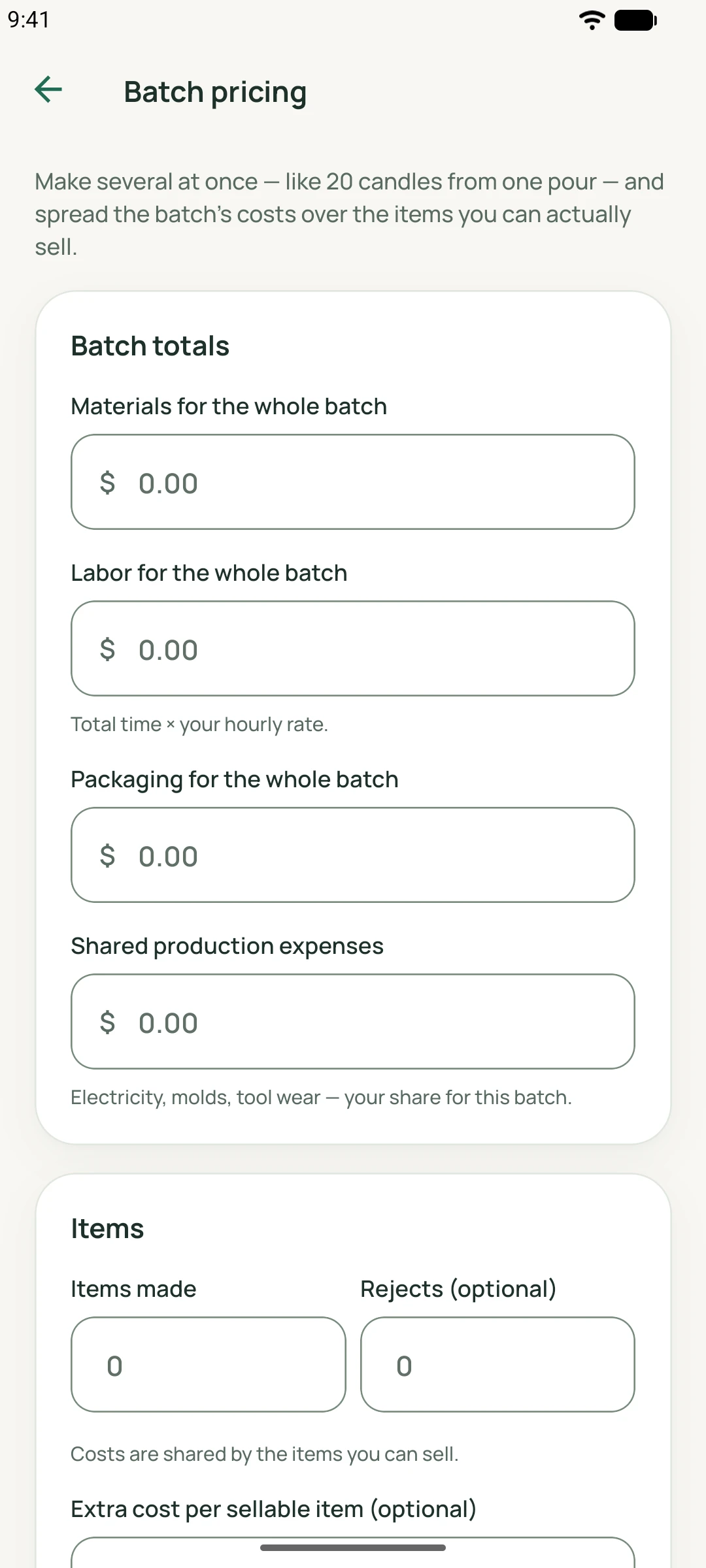
Whole-batch totals include the materials, labor, packaging and shared expenses attributable to the run. A per-item extra is something added for each sellable piece, such as a gift tag, when it is not already included in those totals.
Why rejects raise unit cost
If the shared work and materials have already been spent, a rejected piece does not remove those costs from the batch. Dividing the same total by fewer usable pieces increases the amount each sellable piece must recover.
Separate the cost of waste from the treatment of extras. If gift tags are added only to usable items, rejected pieces need no tags. If packaging has already been used on rejected pieces, that consumed packaging still belongs in the full batch cost. Use inputs that reflect what actually happened.
Build the calculation in a clear order
Cost per usable item = (whole-batch totals + extras per usable item × usable count) ÷ usable count. This is a cost calculation; a selling price still needs a pricing target and the relevant selling expenses.
- Choose what the batch includes and total its material, labor, packaging and shared costs.
- Count all items made and enter rejected pieces separately.
- Add any extras charged only to usable pieces, without repeating costs already in the total.
- Divide total modeled cost by usable output and inspect the change caused by rejects.
- Apply pricing and channel assumptions; review whether the resulting sales contribution can recover the whole batch.
Keep cost recovery separate from a sales forecast
A break-even quantity asks how many sales at the modeled price would cover the batch, after the specified fees and postage. It does not tell you how many pieces customers will buy.
If each sale contributes too little, break-even can exceed the usable batch. That is a reason to review costs and assumptions, not to assume more stock or future demand. Keep actual recorded sales separate from this planning calculation.
Illustrative USD inputs
Twenty candles, with and without rejects
Use USD throughout: whole-batch cost USD 180.00 and an extra USD 1.00 for each usable candle. Selling fees and taxes are excluded from this unit-cost comparison.
| Input or comparison | Calculation |
|---|---|
| No rejects | 20 usable: (180 + 20 × 1) ÷ 20 = USD 10.00 each. |
| Two rejects | 18 usable: (180 + 18 × 1) ÷ 18 = USD 11.00 each. |
| Effect of rejects | USD 1.00 more per usable candle: a 10% unit-cost increase. |
| Cost recovery illustration | At USD 18.00 price, USD 1.00 fees per sale and no postage or tax, USD 17.00 remains per sale. USD 198.00 ÷ USD 17.00 ≈ 11.65: round up to 12 sales. |
The last row introduces an explicit hypothetical selling fee only for cost recovery. The screenshot shows empty setup inputs, not this worked result. No sales or profit are promised.
Putting it into practice in MadeMargin
The app screens below show the relevant tools. They contain demonstration data and are separate from this guide’s worked example.
What this calculation cannot tell you
- At least one usable item is needed; there is no unit price to calculate when the entire batch is rejected.
- Do not count a cost in both batch totals and per-item extras. Your treatment of consumed materials must reflect reality.
- MadeMargin batch costing is not inventory depletion, saved production scheduling or an automatic order system.
Related features
Continue reading
MadeMargin for Android and iOS
See each platform’s current availability on the download page.