
Materials and products
Reuse your supplies. Preserve your product’s numbers.
Store purchase costs and quantities, reuse materials, and organize saved products with cost snapshots and pricing history.
Keep the purchase behind a material connected to the amount you use. Then save the resulting product with its own record, instead of rebuilding the same calculation for every candle or pair of earrings.
Worked guide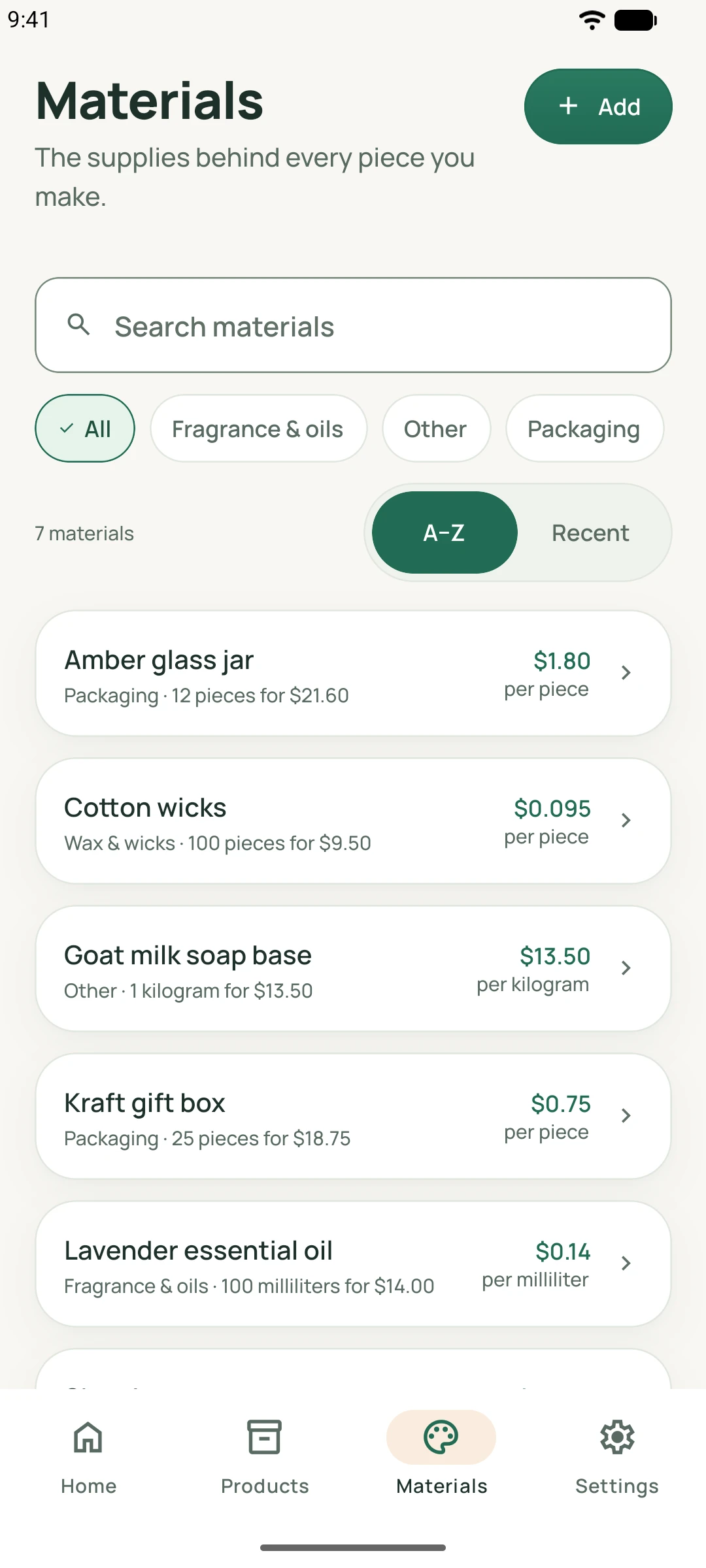
MadeMargin
How it works
Purchase quantities, units and packs
Record the total purchase cost, quantity and unit. Compatible length, mass, volume or count units can convert within their own dimension. A pack needs an explicit number of pieces; one pack is not assumed to mean one piece. Materials also retain their purchase currency.
An organized product record
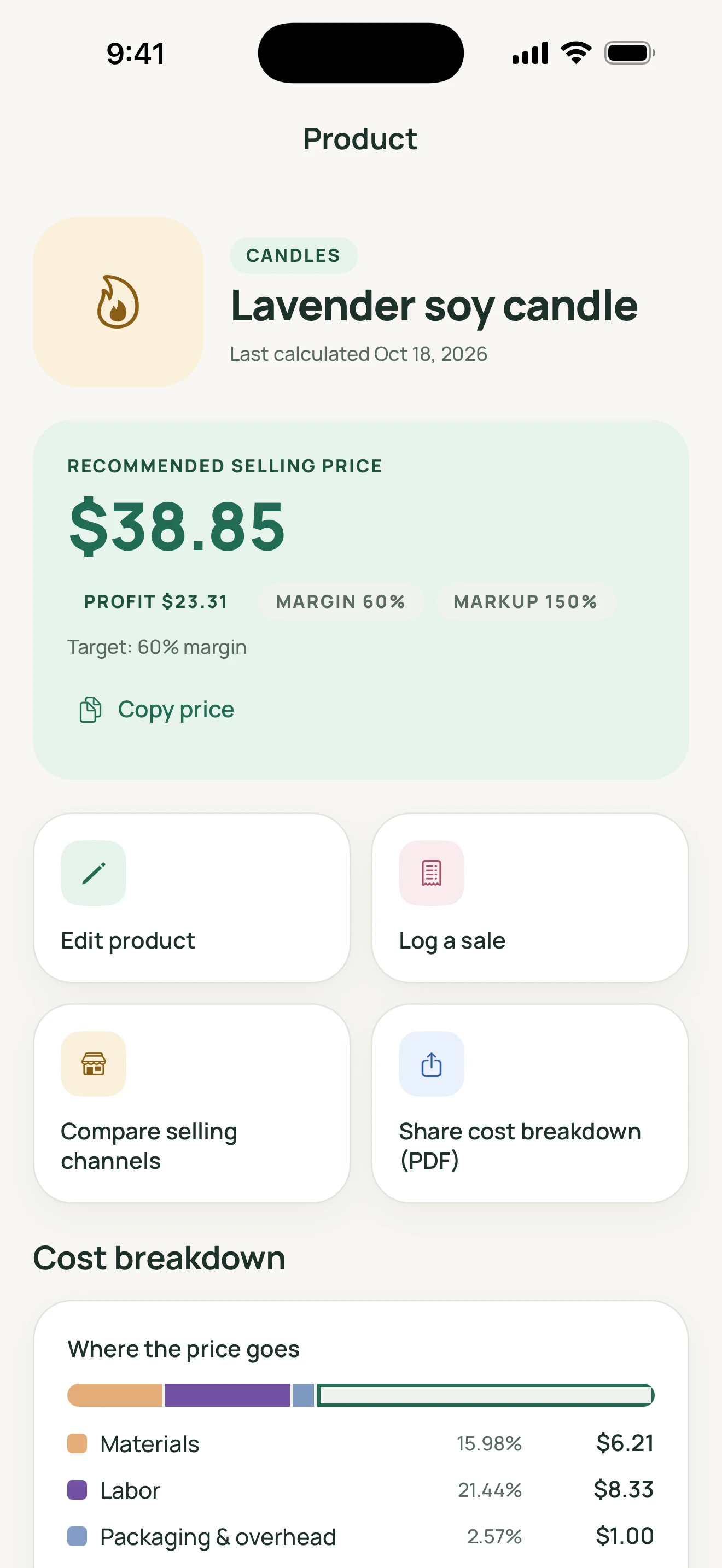
Saved products can include a photo, category and notes, alongside material and pricing snapshots. Pricing history records creation and relevant cost/price changes. The screenshots use category icons; they do not demonstrate a populated photo collection.
Review changes deliberately
Changing a library price does not silently rewrite every product. Review changed material costs, select the updates and save a refreshed snapshot. A deleted or now-incompatible library material cannot supply a normal refresh; the saved product retains its existing snapshot.
A practical workflow
Record the purchase
Enter cost, purchased quantity, unit and, for packs, the number of pieces in a pack.
Use and save
Select materials in the calculator, enter the quantity used and save a product with its identifying details.
Refresh with review
When purchase costs change, inspect eligible changes and choose which to apply to the saved product.
Worked guide
From a purchase to a cost per item
Two independent USD purchases show why quantity and unit belong with the price.
Illustrative inputs, separate from the demo screenshots. These are not customer results or promised outcomes.
| Input or step | Calculation or action |
|---|---|
| 24 jars for USD 36.00 | USD 1.50 per jar; two jars cost USD 3.00. |
| 2 m of fabric for USD 12.00 | 25 cm is 0.25 m; that length costs USD 1.50. |
| A pack entry | For one pack of 24 jars, enter a pack size of 24 rather than treating a pack as a piece. |
These are material costs only. Add labor, packaging and other relevant costs before pricing a finished product.
Feature questions
Will changing a material automatically reprice products?
No. Material-cost refresh is an explicit review-and-save action, with a new product snapshot.
Can I use centimeters from a purchase in meters?
Yes, those are compatible length units. Conversions between different dimensions, such as kilograms and liters, are not supported.
Are product photos uploaded automatically?
No. Photos stay local unless included in a backup or export you share. Optional support images are separately chosen by you.